

Power the Brain to Move the Body

Eric Castillo, finance freshman, boxing during his workout at the UTRGV Recreation Center on the Brownsville campus. Eduardo Rodriguez/Pulse
While weight loss and a built physique are often the main goals of working out, UTRGV students and a professor share why the mental benefits are just as important.
UTRGV psychology Professor Rizza Bermio-Gonzalez said the mind and body are connected.
“A lot of time we think of strategies to help our physical body and then strategies to help our mental health, but overall it’s beneficial to think of strategies for both which helps our mental health,” Bermio-Gonzalez said.
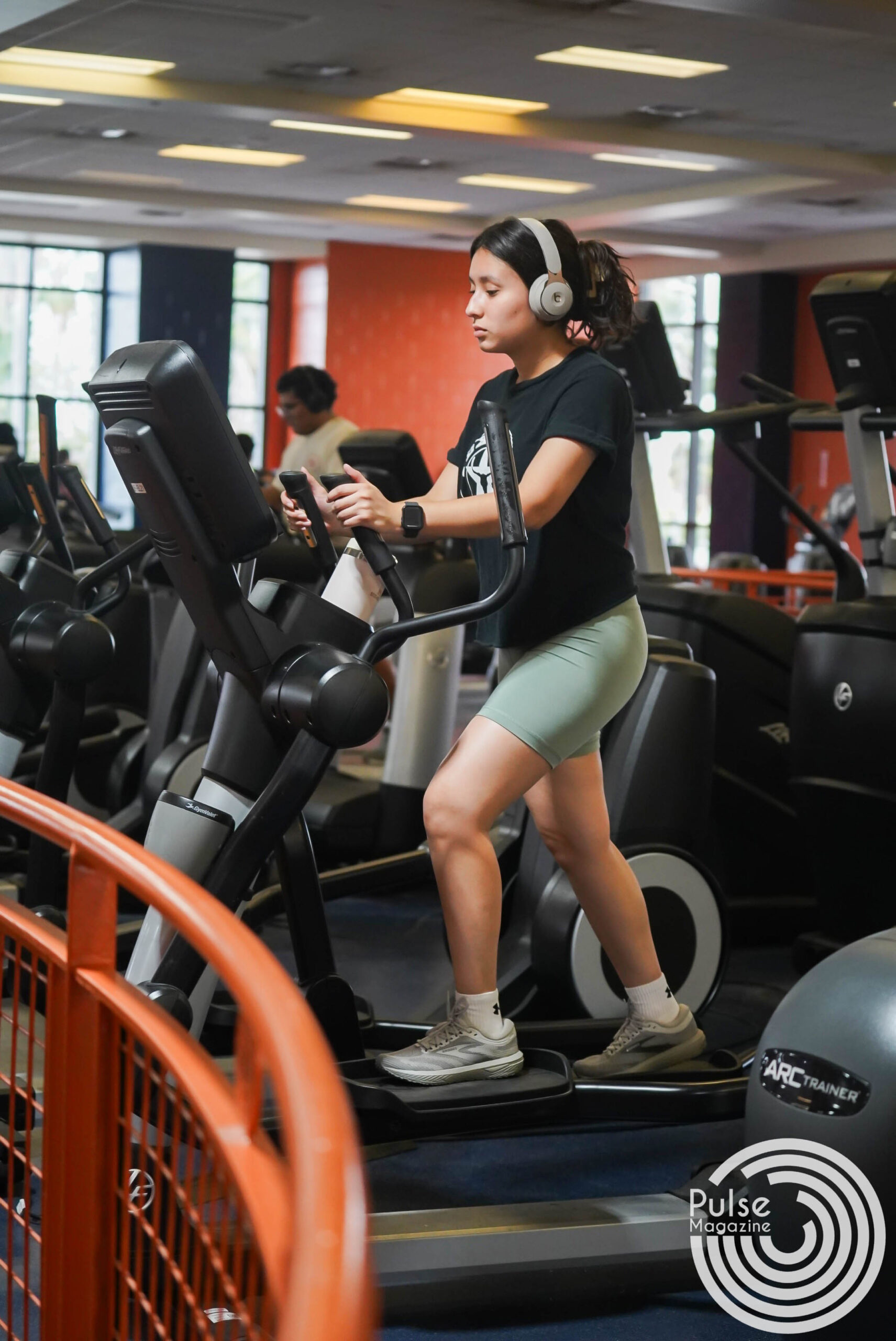
A UTRGV student who has started their athletic journey is Fabian Nerio, a history sophomore.
Nerio said he started working out because of the advantages it can have in his life and the “energized” feeling he gets after a work-out session.
“I feel like on top of the world, all the endorphins are hitting me all at once,” he added.
The professor described this feeling as “runners high,” which is a feeling of euphoria during a run or after a workout caused by endorphins.
“Lets say you’re exercising three or four times a week, that’s actually going to help your brain release endorphins regularly, it’s beneficial for your mood,” she added.
Regarding improved sleep and stress management, Nerio said whenever he’s having a bad day, he goes to the gym to boost his mood and to release stress.
“Exercising reduces things like cortisol, which is our main stress hormone and adrenaline which we also release during stress,” Bermio-Gonzalez said.
Another UTRGV student Joel Villarreal, a history junior, said he goes to the gym for two or three hours.

Villarreal said he came to the gym with depression and alcoholism, but working out has helped give him a sense of drive to continue going and to stop his bad habits.
The professor suggests for people like Villarreal who workout for extended periods of time, to visit a medical provider regularly so they know they are not exerting themselves.
“There tends to be a higher risk of injury when exercising for that amount of time,” she said.
Both Nerio and Villarreal said when it comes to homework and studying, they both procrastinate and struggle with time management.

“In the past I would sometimes prioritize the gym over studying, so personally it hasn’t helped me, it’s actually taking my mindset away from school,” Nerio said.
Professor Bermio-Gonzalez advises students who struggle with time management to try to work out for at least 30 minutes.3
“There’s a study done by Harvard School of Public Health, they found that running for 15 minutes a day reduces risk of depression by 26%,” she said.
Bermio-Gonzalez added exercising can reduce the risk of obesity, cardiovascular disease and type II diabetes because it improves the oxygen throughout the body and immune system.
“In the past, I had low self-esteem which was where my depression came from, as soon as I started to see I was lifting heavy things and being more useful for other people, that’s when I noticed that going to the gym is really good,” Villarreal said.
As said by Professor Bermio-Gonzalez, “health is something that will add to our longevity and helps us live longer.”