

US Government Shutdown Continues
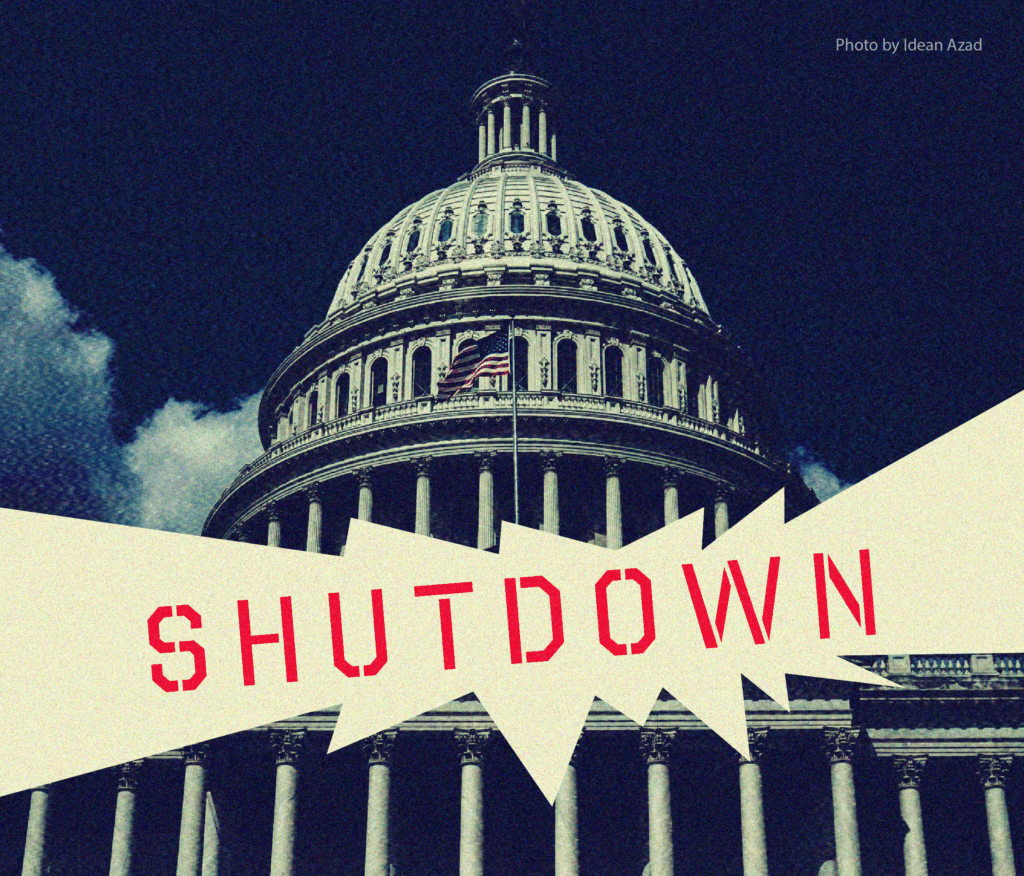
Graphic by Devin Garza
Republicans and Democrats failed to end the U.S. government shutdown for the seventh time on Thursday afternoon.
The shutdown, which began on Oct. 1, is now in its ninth day following a 54 -45 vote on funding priorities in the U.S. Senate.
What is a Government Shutdown?
Mark Kaswan, a political science professor at The University of Texas Rio Grande Valley described a government shutdown as a multistep process in passing a bill through Congress, which is made up of the U.S. House of Representatives and the U.S. Senate.
The process begins with the House, which is made up of 219 Republicans and 213 Democrats, passing a bill with a majority vote (219). Each year, several federal bills have to pass through Congress.
“Because Congress has to pass these bills, it has to go through the House, which is controlled by a majority of either Republicans or Democrats. Right now, it’s Republicans,” Kaswan said.
For the current shutdown, Kaswan explained that Republicans in the U.S. House of Representatives proposed and passed a new budget that included a lot of things that the Democrats very strongly disagreed with. A few Republicans also disagreed with the budget. Nevertheless, it passed through the first step.
Now, the second step is for a bill to pass through the Senate, which Republicans also control.
According to Kaswan, in order for legislation to pass in the Senate, it must get at least 60 votes. This means that though Republicans control the Senate with 53 seats, they still need seven Democrat votes to pass the bill.
“[Democrats] are insisting on restoring some of the things that were stripped out in the bill,” the professor said.
According to him, Republicans wanted to reduce healthcare spending by removing people from Medicaid.
Because Democrats don’t agree with Republicans, “they are trying to use this as a mechanism to actually reverse some of the things that were done,” Kaswan explained.
Since the two parties couldn’t come to agreement by Sept. 30, the U.S. federal government shutdown on Oct.1
Who is Affected?
So far, certain government services have been suspended and federal agencies have categorized workers into the following categories – those who are working and getting paid, people on unpaid leave and people who are working and are not getting paid (excepted employees).
A Sept.30 memo from The Congressional Budget Office stated 750,000 employees could be furloughed each day; the total daily cost of their compensation would be roughly $400 million.
On Tuesday, the Trump Administration announced that the workers were not guaranteed back pay. But on Wednesday, affected agencies and workers received notices that back pay was guaranteed because of the Government Employee Fair Treatment Act of 2019.
Kaswan said he has never seen a situation where people who have been put on furloughs during a shutdown did not get paid back.
For workers who are getting paid, Kaswan explained that various agencies have their own sources of money such as pay entrance fees to National Parks that could cover these salaries.
Some essential services are still available. In an email to Pulse, Daniel Ibarra, chief of interpretation of Palo Alto Battlefield National Historical Park, confirmed that national parks will remain as accessible as possible during the federal government shutdown, but some services may be limited or unavailable.
The U.S. Department of State Bureau of Consular Affairs also released a notice stating that consular operations domestically and abroad will remain operational.
“This includes: passports, visas [and] assisting American citizens abroad,” the statement read.
If you’re a student who has not filled the 2026 FAFSA form, the federal shutdown also doesn’t affect you. According to a statement posted on X on federal student aid, applications can still be completed and student loan payments are still due.
Air traffic controllers are expected to work without pay during a government shutdown. Consequently, several air traffic controllers are calling in sick, causing flight delays and cancellations nationwide.
In a press release issued on Oct. 1, the National Air Traffic Controllers Association’s (NATCA) president, Nick Daniels, explained that “The increased stress and fatigue that comes from working long hours without pay cannot be overstated.”
Speaking on the issue in a press conference Tuesday, Sean P. Duffy, secretary of the U.S. Department of Transportation, acknowledged that air traffic controllers are doing jobs “that are already stressful” and the shutdown has “put way more stress on our controllers at a time when they’re already working on equipment from the 1960s, 1980s, 1990s.”
He added that “These aren’t just controllers, they’re critical infrastructure. They are critical to the operation of the federal government.”
In the Rio Grande Valley, which Kaswan said has “one of the highest concentrations of the National Guard, ICE and Border Patrol,” the shutdown is also having an impact.
Pulse also reached out to the Rio Grande Valley U.S. Customs and Protection, but was not given an interview due to “orders from headquarters,” according to Christina Smallwood, an RGV sector border patrol agent and a public affairs officer.
What Happens Next?
People are also concerned about how long this shutdown will last. The longest U.S. government shutdown lasted 35 days, from Dec. 21, 2018 to Jan. 25, 2019 under the Trump Administration.
Kaswan said he believes this shutdown could last a month and a half.
“I think it’s either going to end fairly quickly or it could last pretty long,” he said.
For Kaswan, the shutdown “could strengthen Trump’s hand, which is something that obviously Democrats really don’t want.”
For now, the professor said the government shutdown will cause pain and make people’s lives harder.
According to him, the purpose of Democrats governing is to alleviate people’s pain.
He added, “The question is, how much pain are the Democrats willing to put up with? For the Republicans, how much pain are they willing to accept?”
Via social media, President Donald Trump said,“I am happy to work with the Democrats on their Failed Healthcare Policies, or anything else, but first they must allow our Government to re-open. In fact, they should open our Government tonight!”