
Monster: Serial killers on screen
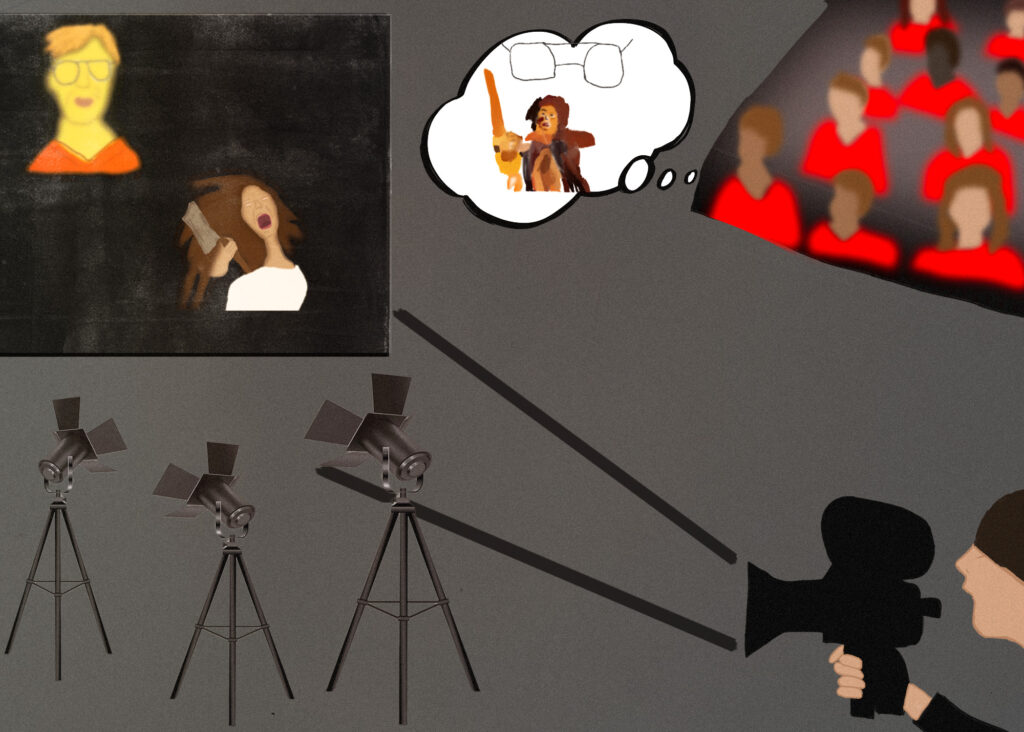
Serial killers have always been part of television. With the Netflix series “Monster,” exploring their personal stories, it’s been questioned by people on the internet if this show glorifies them.
“Monster,” created by Ryan Murphy and Ian Brennan, is a biographical crime drama anthology series on Netflix. Releasing its first season “Monster: The Jeffrey Dahmer story” in 2022, the series dramatizes popular homicide cases in America, exploring the crimes, investigation and impact on the victims of a different killer each season.
The series became a “commercial success,” reaching the number one spot on Netflix in the first week of release and the third Netflix series to pass the 1 billion hours viewed in 60 days.
Anytime a new series is released, the internet comes up with mixed reviews and critiques regarding Murphy’s and Brennan’s work.
Jessica Winter, a reporter for The Newyorker, said “it’s quite impossible that ‘Dahmer,’ despite brilliant performances, has no real justification for its own existence. If it does, it might lie in the stubborn but elusive promise underlying most true crime: that the perpetrator and his acts can be, to some extent, ‘explained.’”
Other’s critiques, such as the one from Tanisha R., a Rotten Tomatoes user, said the series had become a “must watch” for their Halloween list. Tanisha said she found the story “creepy” and found herself completely interested in “trying to understand a person with this mentality.” Tanisha said “who cares if it’s not accurate, I don’t know what’s accurate and what isn’t, the story is compelling regardless.”
Ryan Murphy said he was not really interested in Jeffrey Dahmer the person but what made him the monster he became.
“It’s really about white privilege. It’s about the systemic racism. It’s about homophobia,” Murphy said.
Exploring this in the psychological aspect, Professor Angela Mar, lecturer three in the Department of Psychological Science at UTRGV said every behavior we look at is something within us or in our environment.
“Murder in general, I think it’s interesting to look at the debate of nature versus nurture,” Mar said.
According to the professor, nature is when there is something within us, whether it be something genetically or if there’s something with the brain structure or something “internally wrong.” Nurture would then be the environment.
“In Dahmer’s case it’s of course a mixture. In his case, you could see that it was more of the nurture side. His environment, the situation as he grew up, was traumatic, his environment was abusive and you could see that really affected him, “ Mar said.
Still, she questioned whether that makes you a serial killer, saying there’s a lot of people that come from that kind of background and they don’t kill.
“So then there’s something else at play,” she said.
Film wise, Linda Belau, a professor in the Department of Literature and Cultural Studies and program coordinator of the Film Studies minor program, explored the idea of making a show about serial killers on a platform as Netflix that could be considered a “premium television channel experience.”
“When you’re making a prestige show about a subject, you’re definitely lifting them up somewhat. Do I really want to watch the serial killer TV show on Netflix? It’s a little fetishistic, right?,” Belau said.
She said the representation of serial killers in media is both an important and a problematic thing as there are other people involved in these situations. She used Dahmer as an example, explaining how people liked it and how it’s interesting to learn about him.
The professor said how the show had accomplished something “really interesting” as the showrunners were able to create a “claustrophobic” sense from the first episode and “this kind of creepy attraction to something that’s evil” and how this is not an accident.
“The way the show is structured is not linear. They show the final assault, he’s arrested and he’s talking to the cops and it’s almost like it’s a flashback … Once they start showing the childhood, then you start showing the reasons. Then, is he a monster or is he a victim? That’s kind of what they do with the show,” Belau said.
She asked the problem with all of this is if it should be done? She answered herself saying that is not for her to decide.
“If the American public wants it, the Hollywood industrial complex is going to make it if they can make money off of it,” she said.
On this topic, Aron Cortez, a mass communication senior and the creative director of the Student Film Association, said he thinks it is really unnecessary.
“There has already been so much reporting on it, putting it on screen like that is very irresponsible and gross because the families are still out there and alive, these companies like Netflix are profiting off of their suffering,” Cortez said.
According to him, in filmmaking you are highlighting “a big thing” with history documentaries or biographical films.
“You are glorifying a piece of history. Same thing with these people. No matter how much the directors say they are paying respect, it’s like, no, you are shining a huge light and pointing to a really dark time in all the victims’ history,” Cortez said.
However, audiences keep being interested in this media. Professor Mar said it’s because it draws people’s curiosity.
“People always want to see why people behave a certain way. It draws our interest. Spooky season also kind of prime us into thinking about this kind of theme. […] It’s like seeing a car accident. You don’t want to look but at the same time, you’re drawn to it,” she said.
According to Mar, the reason some people might find empathy in Dahmer’s story is because they could see themselves in him as they might have experienced a similar childhood or see in him similarities to them or they can feel empathy towards him understanding his traumatic background.
“I think that serial killers are something that our society doesn’t want to acknowledge until they see them and then they pervert the reality of what it is and they turn it into something glamorous,” Belau said.
In response to the claim of serial killer shows raising awareness, Professor Belau said, “Just because the person’s on TV, no one really thinks about what’s going on or the collateral damage victims, families of people who are killed this way.”