
The Miracle Drug: society’s decline of body positivity
There seems to be a lot of conversation around being treated a certain way because of your size. The same spaces that used to nurture diversity have now regressed to more traditional views, those views being less inclusive of body positivity.
People online share how they wish they were thinner and how that would solve many problems in their lives. A TikTok user posted a video with the text, “Being a chubby girl in college is humbling.”
Users shared their own stories in the comments of that video. They talked about struggles of fitting in or only being approached when the person needed something but never out of actual curiosity about who they are as human beings.
I see videos like these more often than I would like. I think Gen Z has latched onto an unhealthy obsession with self-image.
But the thing is, I can’t blame them. It seems nowadays your self-image means more than any actual talent or skill. So, the question, “Are you being treated based on your size?” is valid.
In short, yes.
This isn’t a foreign concept, as people have been treated based on their race, gender, etc., for years.
Now, I’m not saying people only mistreat others based on their size; other factors, such as morals, can also be a reason.
There is a quote that says “comparison is the thief of joy.” Arguably, what I’m writing in this column can be invalidated. After all, if I think of myself and not others, then my own life should make me contemptible.
If most arguments were used with that logic, we wouldn’t have made the advancements we have.
So, I want to challenge that quote and the topic that size does influence how you are treated and perceived by the world.
Eve Babitz, a writer and novelist, wrote a poison-pen letter to her friend and fellow writer and novelist Joan Didion. That letter was never sent.
“Just think, Joan, if you were five-feet-eleven and wrote like you do and stuff–people’d judge you differently and your work, they’d invent reasons… Could you write what you write if you weren’t so tiny, Joan? Would you be allowed to if you weren’t physically so unthreatening,” the letter reads.
Didion was known for her icy prose, always being bleak and never dancing around the matter at hand. When Babitz asked the question, “Could you write what you write if you weren’t so tiny, Joan?” she is asking her to think about the privilege her petite size has given her to be able to write as she does without reprimand.
Without Didion’s size, would she be able to get into the political boys’ club and talk as an insider about how they treat the outsiders while still, in retrospect, being an insider?
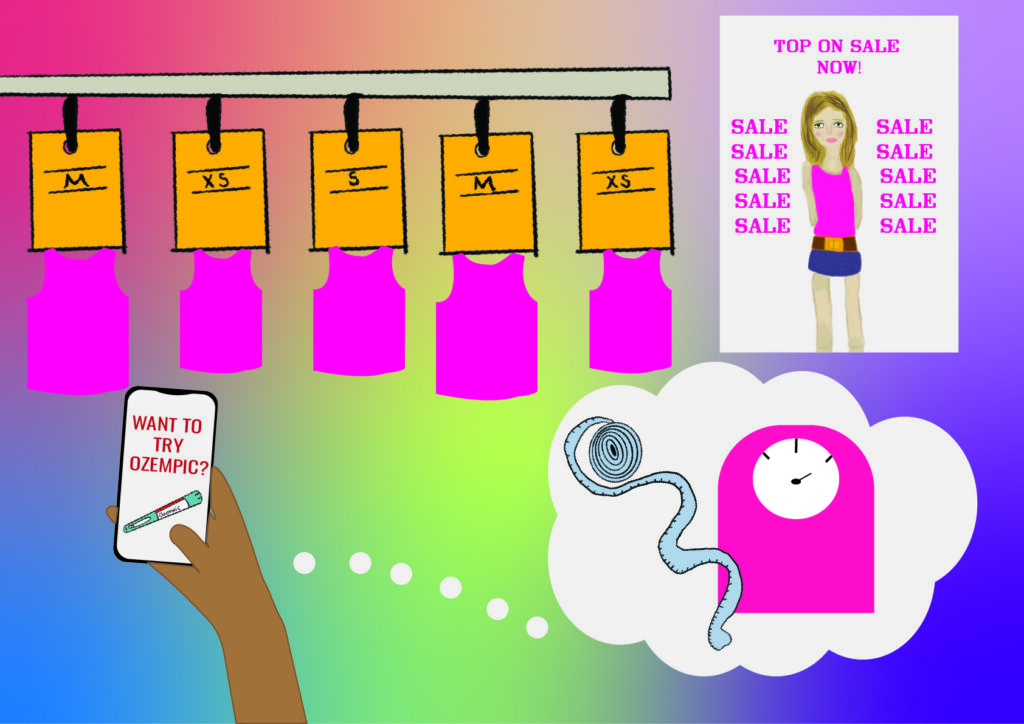
The problem shared by the TikTok user I referenced can be “fixed” with weekly injections of the miracle drug commonly known as Ozempic.
GLP-1s, or medications such as Ozempic and Wegovy, are medications that manage diabetes and promote weight loss.
Although it’s been around since 2020, it seems GLP-1’s supply and demand has skyrocketed overnight.
The company that made Ozempic, Novo Nordisk, has made GLP-1s much more attainable. Near the end of 2025, Novo Nordisk launched a pill version of most GLP-1s.
They have made it easier to get your hands on this medication whether your insurance covers it or not. Noom and Ro are online telehealth services and wellness platforms that both offer the GLP-1 pills and injectables.
If you don’t have diabetes and your insurance doesn’t cover the cost, you can pay the monthly $149, and you can get the medication through these wellness platforms. The question is: What’s stopping you?
Ro and Noom have aesthetically appealing adverts and minimalist branding, using muted colors that highlight the ad’s message: A weekly shot to lose weight. The companies even go as far as using celebrities, such as Serena Williams and Rebel Wilson, as spokespersons to make medication more appealing.
Several students I have spoken to agree the medication is being misrepresented in the media.
One even compared the medication to the U.S., politically regressing and going back to traditional views that do not include body positivity.
I do not think medications such as GLP-1 are inherently bad. I do, however, believe the way they have been marketed is bad.
Society is trying to bury a problem that could be fixed with one simple act of acceptance.